
The truth about wireless chaos, clean audio, and what separates pro gear from panic.
“We only need eight mics.”
That’s how it always starts.
But if you’ve ever worked a real conference before, you know the truth:
- General session needs 12.
- Breakout Room A needs 4.
- Room B? An additional 6.
- Oh, and the ballroom next door is running a different event with another 16 wireless channels.
Suddenly, you’re in a hotel with 50+ live wireless microphones floating across multiple rooms. And if those frequencies aren’t perfectly coordinated — or if you’re using cheap gear — things go south fast.
So let’s answer the real question:
How Many Wireless Mics Can You Run at Once — in the Same Venue?
This isn’t about how many mics a brand claims you can run in a vacuum. This is about what works when the rooms are full, the air is saturated with Wi-Fi, and your CEO is on stage streaming live to 3,000 people.
Here’s what we’ve seen work consistently:
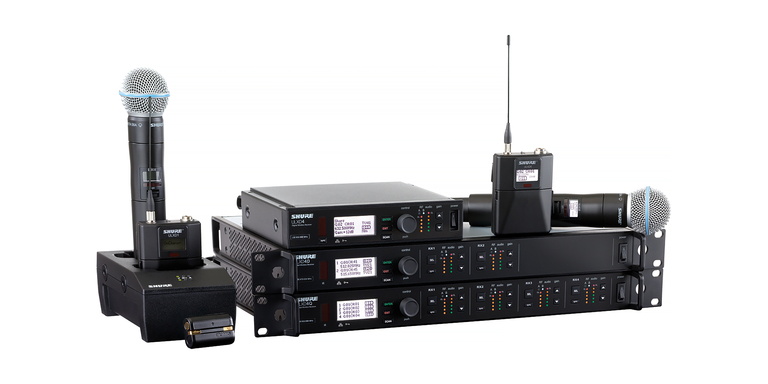
ULX-D (What we use the most)
- Up to 47 channels per 6 MHz band in High Density Mode
- We’ve run 40+ ULX-D mics at once across general sessions and breakouts
- Reliable, clean, and scalable
- Now the standard in many corporate AV setups
SLX-D (Entry-level pro gear)
- We’ve safely used 15–20 channels total while in a controlled venue
- Great for smaller breakout rooms or lower-stakes sessions
- Less efficient spectrum-wise, so it needs planning
Axient Digital (When failure is not an option)
- Up to 63 channels per band in High Density Mode
- Every frequency band is available to switch on the fly
- Built-in interference avoidance and redundant RF paths
- We’ve pushed 64+ channels of Axient in dense RF environments with zero dropouts
The Backbone: Antenna Distribution and RF Management
No matter the system, solid RF infrastructure is a must. That’s why we rely on the RF Venue Diversity Fin (DFIN) antenna.
It gives us:
- Wideband coverage for multiple frequency ranges
- Diversity reception in one clean, compact antenna
- Consistent signal even in difficult venues
We pair that with high-quality distro units and carefully calculated antenna placement. Because it’s not just the mic — it’s the entire signal path that matters.
Cheap Amazon Wireless Systems
We’ve tested them. We’ve seen clients bring them. Here’s the reality:
- 4–6 channels max before you run into interference
- No spectrum coordination, because of cheap components
- Often use unlicensed or illegal frequency bands
- Not suitable for simultaneous room use in a hotel or conference center
One time, years ago, we tried some new 2.4 GHz Line 6 wireless mics for a show at the Fox Theatre. At the time, it seemed like a deal.
Right as the show started, we got hammered with dropouts and RF hits. We scrambled. Moved the antennas near the stage. The mics were still unusable. We returned them the next day and never looked back. We have used Shure mics only since then.
So, What’s the Actual Limit?
There’s no single number. It depends on:
- What system you’re using
- How many rooms are live at once
- The RF noise floor in the venue
- Antenna setup and frequency coordination
But here’s a safe, tested reference:
| System | Channels You Can Realistically Run |
|---|---|
| Shure Axient | 60+ across multiple rooms |
| Shure ULX-D | 40–50 if coordinated |
| Shure SLX-D | 15–20 total |
| Amazon Budget | 4–6 (if you’re lucky) |
Final Thoughts: You’re Not Just Buying a Mic
You’re also buying:
- Signal stability
- Interference protection
- Peace of mind
So when someone asks, “How many wireless mics can I run at once at a conference?” — the answer is:
With pro gear, smart RF planning, and tools like the RF Venue DFIN — as many as you need.
With cheap gear? Hope you brought a wired backup.
Need help planning your next conference? Or unsure if your gear can handle it? We’ve also done this in ballrooms, boardrooms, and broadcast studios, and countless other venues. Let’s talk today before your next big event! Contact Atlanta Pro AV.
See Other APAV projects and products!