

How to Choose the Right Display for Your Corporate Event
If you have ever planned a corporate general session, awards dinner, or product launch in Atlanta or anywhere in the Southeast, you have probably asked this question at some point: Should we use a projector and screen, or go with an LED wall? It sounds like a simple AV decision. In practice, it is one of the choices that most shape the look, feel, and logistics of your entire event.
There is no universal right answer. Both technologies have real strengths, and both come with tradeoffs that are not always obvious until you are in the middle of a load-in with a tight access window and a client asking why setup is running long. Here is what you actually need to know before you commit.
Quick Answer
- Use projection when you need speed, simplicity, and lower overall cost.
- Use an LED wall when you need brightness, visual impact, and a premium broadcast-style look.
Now here is why — and when that quick answer needs more nuance.
| Projection | LED Wall | |
|---|---|---|
| Setup speed | Fast | Slower — plan for it |
| Ambient light | Controlled rooms | Any lighting condition |
| Labor cost | Lower | Higher (more crew) |
| Support structure | Minimal | May need rigging/lifts |
| Camera/streaming | No extra steps | Requires sync planning |
| Scenic value | Screen only | Can replace backdrop/decor |
| Best for | Quick deploys, tight budgets | High-impact, broadcast-style events |
The Case for Projection
Projection is still the workhorse of corporate events, and for good reason. A standard projector-and-screen setup deploys fast. If your venue access is limited to a few hours before doors open, projection is almost always the more practical choice. You are not wrestling with heavy panels, you are not waiting on a ground support structure, and your labor costs stay predictable.
Modern projection has also come a long way in terms of flexibility. Ultra short throw lenses — including extreme UST options with throw ratios as low as .35 — mean you can fill a large screen from just four or five feet of throw distance. Long throw lenses let you shoot cleanly from the back of a large ballroom without obstruction. Browse Atlanta Pro AV’s projector inventory to see the range of options available, from 8,000-lumen workhorses to high-output laser units. If throw distance or ceiling height is a concern, there is almost always a lens solution that gets you where you need to be.
The honest tradeoff: projection consumes floor space or ceiling real estate that could otherwise go toward seating or stage depth. And in rooms with aggressive ambient light — especially daylit spaces with high windows — even a high-lumen projector will struggle. If your venue cannot control the light, that affects image quality in ways that are hard to overcome.
The Case for LED Walls
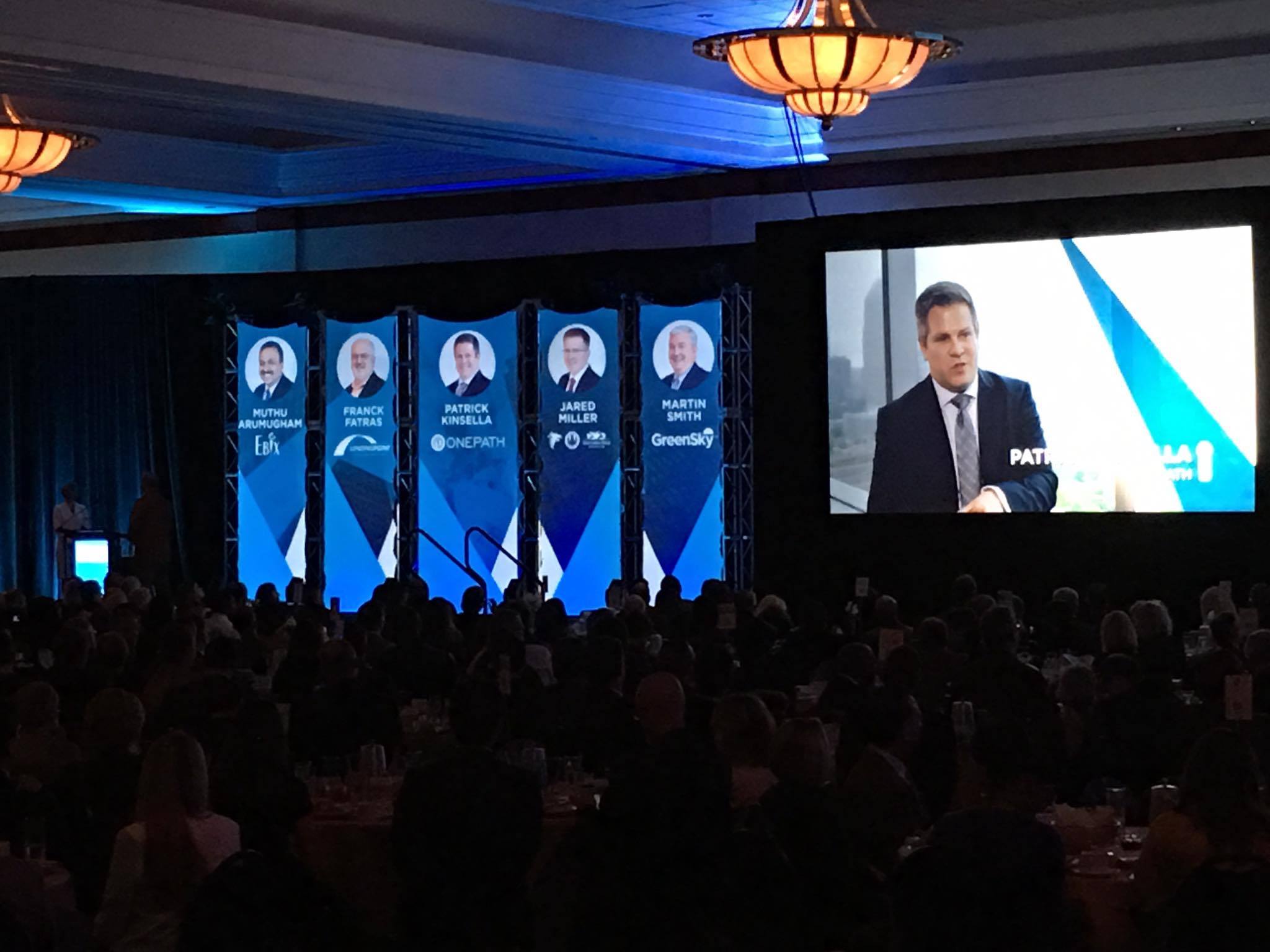
An LED wall changes the visual register of an event entirely. The brightness is self-contained, which means ambient light is essentially a non-issue. The image is sharp, saturated, and consistent whether the house lights are up or down. For a corporate keynote or awards program where you want the stage to look like a broadcast set rather than a hotel ballroom, LED delivers that immediately.
LED walls have also become one of the more cost-effective scenic options available. A large LED backdrop behind a stage, used as an environmental element rather than just a content screen, can eliminate the need for printed backdrops, pipe-and-drape, or custom set pieces. That makes the budget conversation more nuanced than it might first appear.
Logistics
LED walls deliver stunning visuals, but the tradeoffs are real. They take significantly longer to build because the crew has to hang, connect, and calibrate every panel. If you’re working with a tight load‑in or a venue that limits your access time, that pressure forces the team to compress the build—meaning you need more crew, moving faster, which drives up labor costs. What looks like a simple scenic upgrade can quickly turn into a logistics puzzle if the production schedule doesn’t account for it from the start.
There is also the support structure question. Depending on the size of the wall and the venue, you may need staging, ground support lifts, or rigging to get the panels where they need to be. Those are real line items that do not always show up in an initial quote, and they can catch planners off guard if the conversation does not cover them early. The LED wall services page covers the different support configurations Atlanta Pro AV uses — it is worth reviewing if you are evaluating options for the first time.
One Factor That Often Gets Overlooked
If your event is being recorded or broadcast — and increasingly, most corporate events are — LED introduces a consideration that does not apply to projection. LED panels operate on a refresh cycle, and depending on camera settings, that cycle can produce a subtle flicker or moiré artifact in the footage. It is not visible to the naked eye in the room, but it can show up on camera.
The fix is straightforward — camera settings can be adjusted to sync with the panel refresh rate — but it requires planning, and it requires a stage deep enough that cameras are not in an awkward position relative to the wall. If your production team is not looped in early, this is the kind of thing that surfaces during rehearsal rather than in advance.
How to Think Through the Decision
A few questions worth working through with your AV partner before the decision is locked:
- How much access time does the venue allow for load-in? If it is compressed, projection is lower risk.
- What is the ambient light situation? A naturally bright room changes the math significantly.
- Is the event being recorded or streamed? If so, camera placement and LED compatibility need to be part of the conversation from day one.
- How deep is the stage? LED walls need room behind them and in front of them to work well.
- What is the scenic intent? If the display is doing double duty as a backdrop, LED’s economics start to look very different.
- What does the full support structure cost look like? Rigging, lifts, and staging are part of the LED wall price, whether they appear in the initial quote or not.
The Bottom Line
Neither technology is inherently better. The right answer depends on your venue, your schedule, your production goals, and your budget — and the honest version of that budget includes all the supporting elements, not just the display itself. The planners who get this right are the ones who have the conversation early, before the production schedule is locked and before the scope is fixed.
Atlanta Pro AV has been producing corporate events in Atlanta and across the Southeast since 2008. If you are working through this decision for an upcoming event and want a straight answer based on what your program actually requires, reach out for a quote, and we will walk through it with you.